+86 199 4927 3927




+86 199 4927 3927


+86 199 4927 3927
Can Palm Shell Activated Carbon Replace Coconut Shell Carbon? When to Switch and When Not to
Nov. 09, 2026
Sometimes, but not in every application. Palm shell activated carbon can be a suitable alternative when its adsorption performance, hardness, particle size and other properties meet the process requirements. In some applications, it may even offer a better cost-performance balance.
However, coconut shell activated carbon remains a proven choice for applications such as gold recovery, where hardness, abrasion resistance and adsorption performance are critical.
Coconut shell activated carbon is usually more expensive than palm shell activated carbon. For buyers trying to control purchasing costs, switching to palm shell carbon may seem like a reasonable option.
But a lower purchase price does not always mean lower operating costs. And a higher price does not mean every application needs coconut shell carbon.
Both materials can produce activated carbon, but their final properties depend on more than the raw material. Carbonization, activation, washing, and other processing steps all affect pore structure, adsorption performance, hardness, and ash content.
In some applications, palm shell activated carbon may be a suitable alternative to coconut shell carbon. In others, switching could affect treatment performance or carbon service life.
The same applies in the opposite direction. Coconut shell carbon is not automatically the better choice for every application. Palm shell carbon may perform better in certain wastewater treatment processes or applications that require a particular pore structure.
The real question is not which raw material is better. It is when can one replace the other, and when should you keep using the carbon that has already been proven in your process?
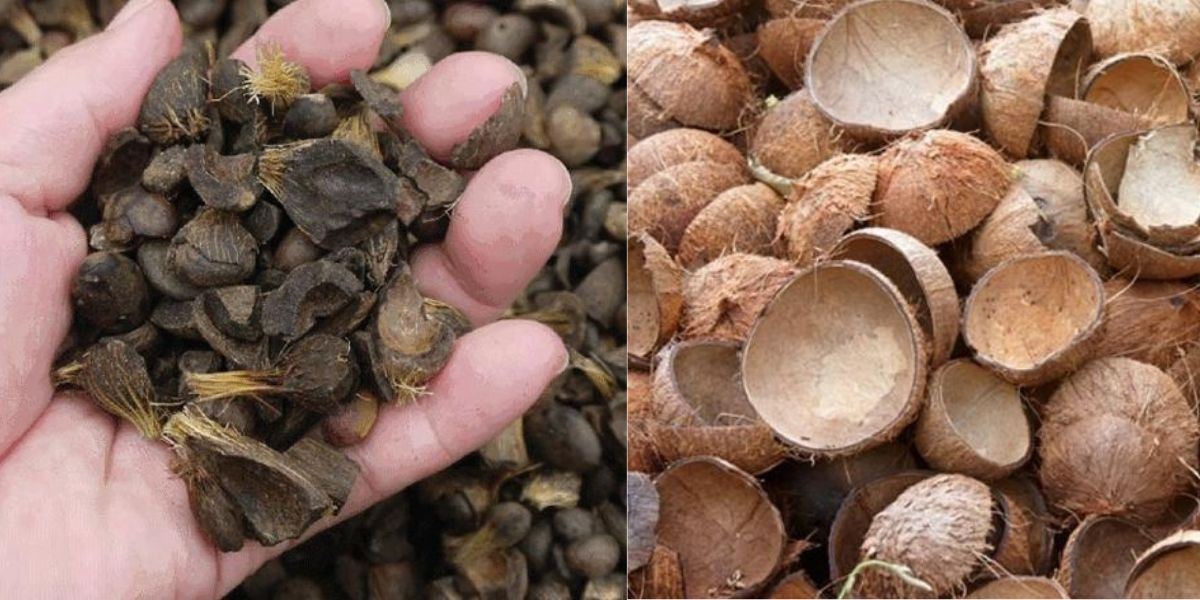
Both are made from hard shell materials commonly sourced from Southeast Asia. They may look similar as finished granular products, but their properties can differ.
|
Property |
Coconut Shell Activated Carbon |
Palm Shell Activated Carbon |
|
Raw material |
Coconut shells |
Oil palm shells |
|
Pore structure |
Commonly microporous; depends on activation conditions |
Micropore and mesopore distribution depends on the raw material and process |
|
Hardness and abrasion resistance |
Commercial grades are generally known for good mechanical strength |
Must be checked against the actual product data |
|
Ash content |
Mature production processes can achieve good ash control |
Also depends on raw material and post-treatment |
|
Common applications |
Gold recovery, water treatment, air purification |
Used in selected wastewater treatment and other adsorption applications |
|
Market supply |
More established production and supply channels |
Supply maturity varies by producer and region |
One point needs to be clear: the raw material alone does not determine the quality of activated carbon.
Even when the same raw material is used, different carbonization temperatures, activation times, activating agents, washing processes, and screening methods can produce very different products.
A product should not be judged by the words "coconut shell" or "palm shell" on its packaging. Its actual specifications matter more.
This is where simple comparisons can be misleading.
A study published in Bioresource Technology in 2004 compared the pore development of activated carbon made from palm shell and coconut shell under the same carbonization and activation conditions.
Under those experimental conditions, palm shell activated carbon showed higher micropore and mesopore volumes. Coconut shell char, however, had a much faster activation rate, reported to be about five times that of palm shell char.
The study shows that the two raw materials can develop different pore structures and activation characteristics under the same processing conditions.
It does not mean every commercial palm shell product will have more pores, or that every coconut shell product will activate faster. Production conditions make a real difference.
For buyers, these are the properties worth checking:
Micropores, mesopores, and macropores play different roles in adsorption.
Micropores are important for adsorbing many small molecules. Mesopores help larger molecules enter the carbon structure and move through it. Macropores mainly act as transport channels.
If the target contaminant has relatively large molecules, or diffusion through the pores limits adsorption, iodine value alone will not tell you enough. Pore size distribution and methylene blue value may also need to be checked.
Mechanical strength matters when activated carbon operates continuously in a water or gas stream. It is especially important in processes such as gold recovery, where carbon may be handled and reused repeatedly.
Carbon that breaks down too easily can cause carbon loss, increase fines in the system, and create additional filtration or maintenance work.
Coconut shell activated carbon has a strong reputation for hardness and abrasion resistance. Still, buyers should compare the actual hardness, abrasion, and particle size data rather than rely on the raw material name.
Ash content can affect the effective adsorption capacity of activated carbon and may cause problems in processes that are sensitive to inorganic impurities.
Ash content is not determined by the raw material alone. Raw material quality, carbonization, activation, and washing all have an impact.
Iodine value, methylene blue value, surface area, and pore structure help describe an activated carbon product. None of them can represent performance in every application.
For a specific contaminant, dynamic adsorption capacity, breakthrough time, and actual removal efficiency may be more useful than a single laboratory index.
The answer depends on the application. A product that works well in one process may not be suitable for another.
For some conventional industrial wastewater treatment and general organic adsorption applications, palm shell activated carbon may be considered as an alternative to coconut shell carbon.
This is possible when the two products have comparable properties and the replacement meets the requirements of the treatment system.
Do not make the switch based on iodine value alone.
For example, if the existing system uses coconut shell granular activated carbon with low ash content and good mechanical strength, the replacement product must meet the relevant requirements for strength, particle size, and adsorption performance.
If the new carbon produces more fines, increases filter pressure drop, or needs more frequent replacement, the initial savings may disappear quickly.
Coconut shell activated carbon has an established commercial role in gold recovery processes such as CIP, CIL, and CIC.
Gold recovery requires more than good adsorption capacity. Buyers also need to consider:
If a plant is already using a proven coconut shell grade, switching to a cheaper palm shell product without proper testing is a risk.
The alternative should be tested under actual process conditions, including adsorption, attrition, and repeated use. A lower quotation does not automatically make it the more economical option.
Activated carbon is used in industrial gas treatment to remove VOCs, hydrogen sulfide (H₂S), odors, and other contaminants.
Different gases require different adsorption properties and surface chemistry.
Impregnated activated carbon is a good example. Its performance depends not only on the carbon base but also on the type and loading of the impregnant and how it reacts with the target gas.
A standard palm shell carbon should not be used as a direct replacement for a specially selected or impregnated coconut shell product.
Before changing the carbon, check:
If the process requires specific pore characteristics, mechanical strength, or chemical treatment that the alternative cannot provide, changing the carbon just to reduce the purchase price makes little sense.
This is an application worth looking at from the other direction.
Some studies on palm oil mill effluent (POME) have reported better COD adsorption capacity or removal performance from palm shell activated carbon than from coconut shell carbon under the tested conditions.
That suggests palm shell carbon may be a better fit for certain wastewater characteristics and treatment conditions.
It does not mean palm shell carbon is always the right choice for POME, or that coconut shell carbon cannot treat this type of wastewater.
The result depends on the wastewater composition, pH, initial COD, carbon dosage, contact time, and the properties of the activated carbon itself.
This is a useful reminder: coconut shell carbon is not the answer to every adsorption problem. Palm shell carbon should not be dismissed simply because it is less common in some markets.
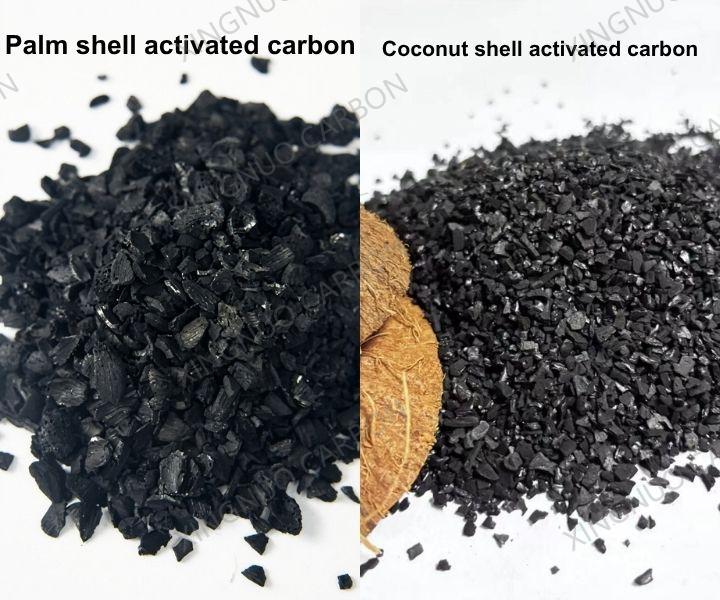
Buyers often ask why coconut shell activated carbon costs more when palm shells are also widely available in countries such as Indonesia and Malaysia.
The price difference is not simply a matter of raw material cost. Supply chain development, production experience, manufacturing scale, and market demand all play a part.
Coconut shell activated carbon has a relatively mature production system in China.
Over the years, manufacturers have developed established sourcing channels and accumulated experience in carbonization, activation, processing, and quality control. This makes it easier for experienced producers to maintain consistent quality and supply products in larger quantities.
Palm shells are abundant in some Southeast Asian countries, but raw material availability does not automatically create a mature industrial supply chain for activated carbon.
The supply of carbonized palm shell material, processing experience, and large-scale production capacity can vary considerably between suppliers. These differences may affect product consistency, lead times, and the ability to supply large orders.
Coconut shell activated carbon has an established market position in gold recovery, water treatment, and air purification.
Buyers are familiar with these products, and manufacturers have a clear reason to keep investing in production equipment, process improvements, and quality control.
Palm shell activated carbon also has potential, but commercial experience and customer validation are less established in some markets and applications.
For a manufacturer, developing a product is not just about proving that it can be made. The product also needs to be produced consistently, supplied in commercial quantities, and supported by sufficient market demand.
Our own product strategy is based on the production and supply system we have developed over the years.
We currently focus on coconut shell activated carbon because we have more established experience in its sourcing, production processes, and quality control. This gives us a stronger basis for maintaining product consistency and stable supply.
Palm shell activated carbon has not yet reached the same level of maturity within our own production and supply system. Developing it on a large scale would require further investment in raw material selection, process development, quality control, and market validation.
For this reason, we do not currently produce palm shell activated carbon in large quantities. We put more of our resources into coconut shell products.
This is a decision based on our own manufacturing experience and supply capabilities. It should not be taken to mean that palm shell activated carbon is necessarily inferior.
With suitable raw materials and well-controlled production processes, palm shell can also be used to make activated carbon with good adsorption properties. At present, coconut shell carbon is simply the product that better matches our existing production experience and supply system.
If you are considering switching from coconut shell to palm shell carbon, or the other way around, do not make the decision based on the quotation alone.
A few checks can help avoid costly mistakes.
Record the raw material, particle size, iodine value, methylene blue value, ash content, hardness, and moisture content.
For special applications, you may also need pore size distribution and dynamic adsorption data.
Identify the target contaminant, inlet concentration, temperature, pH, humidity, flow rate, contact time, and current carbon service life.
Do not focus on iodine value alone. Select the properties that have a direct effect on your process and compare those values between the existing product and the proposed replacement.
If the alternative meets the basic specifications, test it under conditions as close as possible to the actual process.
Look beyond initial adsorption results. Check service life, fines generation, carbon loss, regeneration performance, maintenance requirements, and replacement frequency.
The aim is to find out whether the alternative can do the same job reliably, not just whether it looks similar on a test report.
There is no single raw material that works best for every activated carbon application.
If your process requires specific hardness, abrasion resistance, pore characteristics, or long-term operating stability, and a coconut shell grade has already been proven in your system, keeping that grade may be the safer decision.
If your application has less demanding requirements and a palm shell product can meet the necessary specifications and treatment performance, it is worth evaluating, especially when purchasing cost is a major concern.
The same applies in reverse. If palm shell activated carbon provides a more suitable pore structure or better treatment results in a particular application, there is no reason to choose coconut shell simply because it is more widely recognized.
Before making a decision, ask four questions:
Do not assume palm shell can replace coconut shell just because it costs less. Do not assume every application needs coconut shell just because it has stronger market recognition.
The right activated carbon is the one that performs reliably in your process, not simply the one with the more familiar raw material name.
It can be, depending on the production process and application. Neither raw material guarantees better performance. Compare the finished products through actual test data.
Its established supply chain, mature production experience and strong market demand in applications such as gold recovery contribute to its price.
Potentially, but it must meet the requirements for gold loading, adsorption kinetics, hardness, abrasion resistance and particle size. Do not switch based on price alone.
No. The suitable choice depends on the water quality, target contaminants and treatment conditions. Some studies have reported good results with palm shell activated carbon in POME treatment.
Compare technical specifications, review test reports and conduct a small-scale trial if necessary. Also consider service life, carbon loss, replacement frequency and total operating cost.

Previous:
None

Related Products
Size: 100–325 mesh (customizable)
Used for: Wastewater treatment, decolorization, waste incineration
Size: 100×100×100 mm, 100*100*50mm,
Used for: VOC removal, exhaust gas purification, spray booths
Sizes: 1.5 mm, 2 mm, 3.0 mm, 4.0 mm, 6.0 mm
Used for: Gas purification, solvent recovery, biogas desulfurization
Size: 1.5 mm, 3.0 mm, 4.0 mm; 4×8, 8×30 mesh
Used for: H2S, acid gas, ammonia, and mercury removal
Coal-Based Tar Columnar Activated Carbon
Sizes: 1.5 mm, 2 mm, 3 mm, 4 mm, 6 mm, 8 mm, and customized sizes
Used for: Industrial waste gas treatment, solvent recovery, mercury removal, desulfurization and denitrification, gas purification
Size: 100–325 mesh (customizable)
Used for: Wastewater treatment, decolorization, waste incineration
Size: 4×8 – 12×40 mesh (GAC); 1.5 – 4.0 mm (Pellets); 200 – 325 mesh (PAC)
Used for: Industrial Gas Purification, VOC Adsorption, Wastewater Treatment, Solvent Recovery, Biogas Desulfurization, PSA Nitrogen Deoxygenation, Flue Gas Treatment
Coconut Shell Granular Activated Carbon
Size: 4-8, 6×12, 8×16, 8×30, 12×40, 30×60, 100, 200, 325 mesh (customized size available)
Used for: Drinking water and industrial water treatment, wastewater treatment, gold recovery (CIP/CIL/CIC), air purification, food and beverage decolorization, pharmaceutical purification.