+86 199 4927 3927




+86 199 4927 3927


+86 199 4927 3927
How to Treat Preg-Robbing Carbonaceous Gold Ores
Nov. 06, 2026
Gold recovery plants processing carbonaceous ores often face a frustrating problem: cyanide consumption rises, activated carbon loads poorly, and gold recovery suddenly drops — even when the leaching circuit itself appears to be operating normally.
In many cases, the issue is not the cyanide system, but the ore itself.
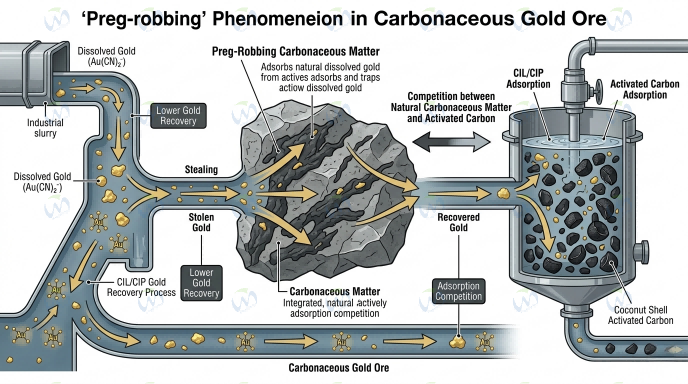
Some gold ores contain naturally occurring carbonaceous matter that behaves similarly to activated carbon. During cyanidation, these materials adsorb dissolved gold cyanide complexes before the recovery carbon in the CIL/CIP circuit can capture them.
This phenomenon is known as preg-robbing.
For mining operations, preg-robbing can become one of the most difficult challenges in gold recovery, especially when standard activated carbon performs too slowly or loses activity under harsh operating conditions.
This article explains:
• why carbonaceous ores reduce gold recovery,
• why activated carbon selection becomes more critical in preg-robbing ores,
• and how gold plants improve adsorption performance in difficult CIL/CIP operations.
Carbonaceous gold ores contain naturally occurring carbon-rich materials such as:
• organic carbon,
• graphitic carbon,
• and other carbonaceous matter.
These materials can adsorb dissolved gold cyanide complexes during leaching.
In simple terms:
This competition reduces adsorption efficiency and can significantly lower overall recovery performance.
Preg-robbing severity depends on:
• carbon activity,
• ore mineralogy,
• graphitic structure,
• and cyanidation conditions.
In highly carbonaceous ores, the preg-robbing effect may become strong enough to destabilize normal CIL/CIP adsorption performance.
In standard gold recovery circuits, average activated carbon may still achieve acceptable adsorption performance.
But in preg-robbing ores, adsorption competition becomes far more aggressive.
The dissolved gold exists in constant competition between:
• activated carbon in the adsorption circuit,
• and naturally occurring carbonaceous matter inside the ore.
In this situation, activated carbon quality directly affects recovery efficiency.
If adsorption kinetics are too slow, the ore may adsorb dissolved gold before the activated carbon has enough time to recover it.
This is why preg-robbing operations usually require activated carbon with:
• faster adsorption kinetics,
• high abrasion resistance,
• stable regeneration performance,
• optimized pore structure,
• and low platelet generation.
In difficult ores, small differences in activated carbon performance can sometimes create major differences in final gold recovery.
Many plants do not immediately realize that carbonaceous matter is affecting adsorption performance.
Typical operational symptoms include:
• unexpectedly low gold recovery,
• poor carbon loading,
• increased cyanide consumption,
• unstable adsorption efficiency,
• elevated tailings grade,
• and excessive carbon fines generation.
In severe cases, operators may notice that recovery continues to decline even after increasing cyanide dosage or extending leaching time.
Preg-robbing behavior is especially problematic in adsorption systems such as CIL and CIP, where activated carbon performance directly determines recovery efficiency.
If you would like to understand the operational differences between these two gold recovery methods, you may also read:
Differences Between CIP and CIL
In preg-robbing ores, adsorption speed becomes extremely important.
The longer dissolved gold remains in solution, the more opportunity carbonaceous matter has to re-adsorb it.
High-performance activated carbon helps reduce this competition window.
Activated carbon with faster adsorption kinetics can:
• capture dissolved gold more quickly,
• improve adsorption efficiency,
• reduce gold losses,
• and stabilize recovery performance in difficult ores.
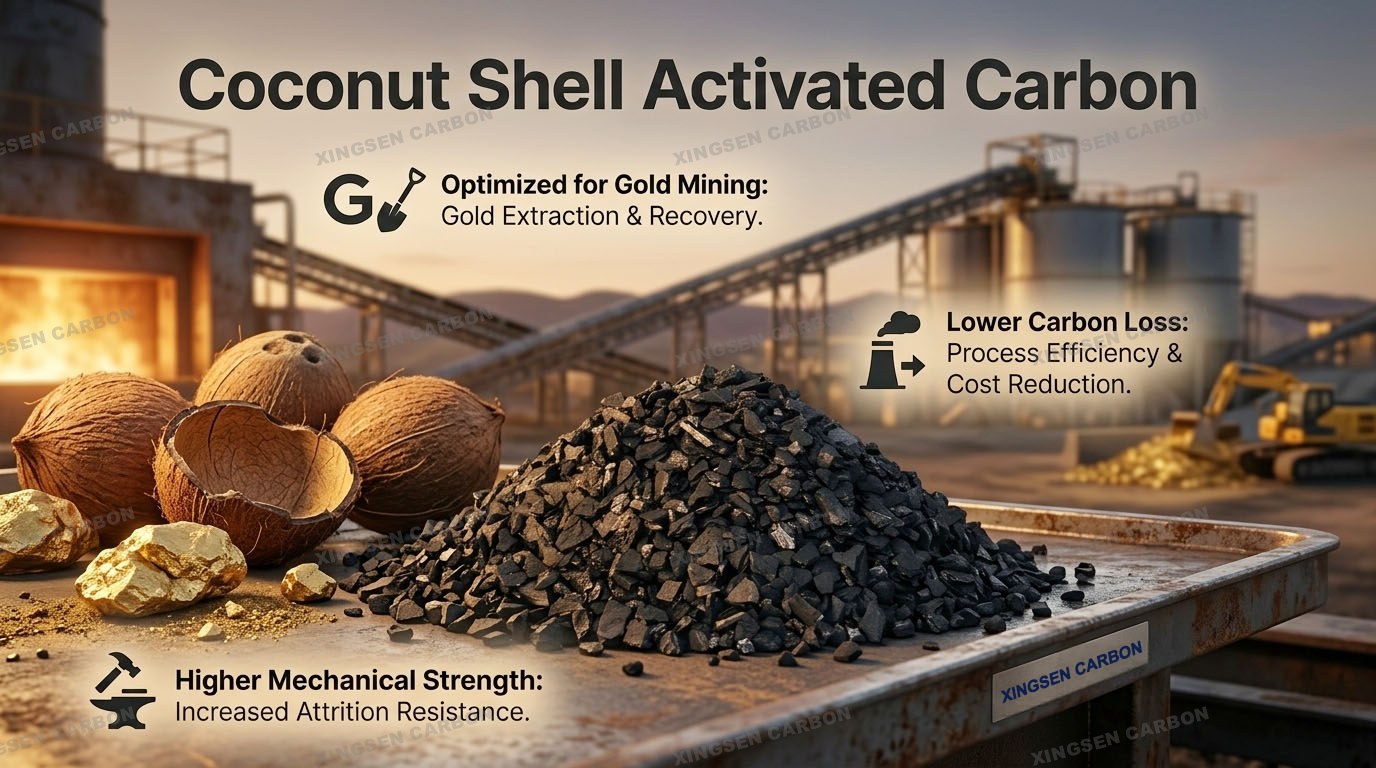
This is one reason coconut shell activated carbon is widely used in gold recovery applications.
Compared with lower-hardness carbons, coconut shell carbon generally provides:
• better wear resistance,
• lower carbon loss,
• higher mechanical strength,
• and more stable long-term operation in agitated CIL/CIP systems.
Not all activated carbon performs equally in difficult gold recovery environments.
For preg-robbing ores, several characteristics become especially important.
Rapid adsorption improves the ability of activated carbon to compete against naturally occurring carbonaceous matter.
Gold recovery circuits generate continuous abrasion. High-hardness carbon reduces breakage and minimizes carbon losses.
Gold adsorption depends not only on surface area, but also on pore accessibility and pore size distribution.
A well-developed pore structure helps improve adsorption efficiency under industrial conditions.
Excessive fines generation can reduce recovery efficiency and increase downstream operational problems.
Gold recovery carbon is commonly regenerated multiple times. Stable regeneration performance helps maintain adsorption activity over repeated cycles.
Several industrial methods are commonly used to reduce preg-robbing behavior, including:
• blinding agents,
• flotation pre-treatment,
• roasting,
• BIOX,
• and resin systems.
Some of these methods can significantly improve recovery performance.
However, many gold plants avoid major process modifications because of:
• high CAPEX,
• energy consumption,
• environmental restrictions,
• and operational complexity.
As a result, many operations first attempt to improve recovery within the existing CIL/CIP circuit by optimizing:
• activated carbon performance,
• adsorption efficiency,
• cyanide conditions,
• and carbon management.
In practice, improving the quality of activated carbon is often one of the fastest and most economical ways to stabilize adsorption performance before implementing larger process changes.
In addition to selecting suitable activated carbon, many operations improve recovery through process optimization strategies.
Typical approaches include:
• maintaining proper carbon inventory,
• increasing carbon activity monitoring,
• optimizing cyanide dosage,
• improving slurry mixing,
• reducing carbon attrition,
• and controlling carbon fouling.
For preg-robbing ores, adsorption efficiency is usually influenced by both:
• ore mineralogy,
• and activated carbon performance.
Successful recovery often requires balancing both factors rather than focusing on only one part of the process.
Activated carbon used in gold recovery circuits should maintain:
• rapid adsorption performance,
• high mechanical strength,
• low attrition loss,
• and stable regeneration behavior.
For many mining operations, coconut shell activated carbon remains the preferred choice because of its:
• high hardness,
• excellent wear resistance,
• stable adsorption efficiency,
• and suitability for continuous CIL/CIP operation.
Selecting suitable activated carbon is especially important in preg-robbing ores, where adsorption competition becomes much more severe than in conventional gold recovery operations.
Preg-robbing carbonaceous ores remain one of the most challenging problems in gold recovery operations.
When naturally occurring carbonaceous matter competes with activated carbon for dissolved gold, adsorption efficiency can decline rapidly, leading to lower recovery and higher operating costs.
Although pretreatment technologies such as roasting, flotation, and BIOX may help reduce preg-robbing behavior, the performance of activated carbon remains critical for maintaining stable adsorption efficiency in CIL/CIP systems.
In many operations, improving activated carbon quality is one of the most practical and cost-effective ways to improve gold recovery performance before major process modifications are considered.
1. What is a preg-robbing gold ore?
A preg-robbing ore contains carbonaceous matter that adsorbs dissolved gold during cyanidation.
2. Why do carbonaceous ores reduce gold recovery?
Natural carbon in the ore competes with activated carbon for dissolved gold.
3. What are common signs of preg-robbing?
Low gold recovery, poor carbon loading, and high cyanide consumption are common signs.
4. How is preg-robbing measured?
Plants commonly use PRI tests, bottle roll tests, and diagnostic leaching.
5. Can activated carbon improve recovery in preg-robbing ores?
Yes. Faster adsorption carbon can help reduce gold losses in CIL/CIP systems.
6. Why is coconut shell activated carbon used in gold recovery?
It offers high hardness, low attrition, and stable adsorption performance.
7. What carbon properties are important for gold recovery?
Fast adsorption, high hardness, optimized pores, and low fines generation.
8. What treatments are used for carbonaceous gold ores?
Common methods include blinding, roasting, flotation, BIOX, and RIL systems.
9. Can process optimization alone solve preg-robbing?
Not always. Severe ores may require both process changes and better activated carbon.
10. Are carbonaceous ores always refractory ores?
No. Some ores are carbonaceous, some are refractory, and some are both.
Related Products
Size: 100–325 mesh (customizable)
Used for: Wastewater treatment, decolorization, waste incineration
Size: 100×100×100 mm, 100*100*50mm,
Used for: VOC removal, exhaust gas purification, spray booths
Sizes: 1.5 mm, 2 mm, 3.0 mm, 4.0 mm, 6.0 mm
Used for: Gas purification, solvent recovery, biogas desulfurization
Size: 1.5 mm, 3.0 mm, 4.0 mm; 4×8, 8×30 mesh
Used for: H2S, acid gas, ammonia, and mercury removal
Coal-Based Tar Columnar Activated Carbon
Sizes: 1.5 mm, 2 mm, 3 mm, 4 mm, 6 mm, 8 mm, and customized sizes
Used for: Industrial waste gas treatment, solvent recovery, mercury removal, desulfurization and denitrification, gas purification
Size: 100–325 mesh (customizable)
Used for: Wastewater treatment, decolorization, waste incineration
Size: 4×8 – 12×40 mesh (GAC); 1.5 – 4.0 mm (Pellets); 200 – 325 mesh (PAC)
Used for: Industrial Gas Purification, VOC Adsorption, Wastewater Treatment, Solvent Recovery, Biogas Desulfurization, PSA Nitrogen Deoxygenation, Flue Gas Treatment
Coconut Shell Granular Activated Carbon
Size: 4-8, 6×12, 8×16, 8×30, 12×40, 30×60, 100, 200, 325 mesh (customized size available)
Used for: Drinking water and industrial water treatment, wastewater treatment, gold recovery (CIP/CIL/CIC), air purification, food and beverage decolorization, pharmaceutical purification.